Introduction
In the digital age like today, organizations increasingly rely on vast amounts of data for analytics, research, and innovation. Protecting individual privacy while extracting meaningful insights from data is a crucial challenge. Data anonymization is a key method aimed at removing personally identifiable information (PII) from datasets, thus preserving privacy. Yet, the rapid advances in data analysis, machine learning, and the growth of auxiliary data sources have made anonymized data vulnerable to re-identification attacks. This fragile balance between privacy protection and data utility remains a central concern for data practitioners, policymakers, and privacy advocates advancing data anonymization techniques, limits of data anonymization.
Comprehensive Overview of Data Anonymiztion Techniques
Data anonymization involves various techniques aiming to protect sensitive data while retaining its usefulness. These techniques transform raw data to reduce the risk of identifying individuals without completely discarding the analytical value of the data. The most commonly applied methods include:
Generalization and Suppression
Generalization reduces the granularity of data by replacing specific values with broader categories. For instance, exact ages may be generalized into age ranges or birthdates truncated to years only. Suppression involves removing sensitive data fields wholly or partially. Both are foundational techniques used in demographic analyses and market research to limit direct identification risks detailed technique comparison.
Data Masking
Data masking entails altering or obfuscating sensitive fields while maintaining the format and basic structure of the data to support realistic analysis. Static Data Masking (SDM) permanently modifies data, guaranteeing no recovery of the original, whereas Dynamic Data Masking (DDM) obscures data on the fly during query time. Techniques range from character substitution to tokenization, providing flexible protection for environments such as software development and testing.
Data Perturbation and Noise Addition
Perturbation modifies data points slightly but systematically to protect individual information without destroying overall dataset characteristics. Noise addition involves inserting random variation, typically drawn from a probability distribution such as Gaussian noise, to sensitive data points. This approach provides strong privacy in contexts where exact values are less critical than overall data trends randomization techniques.
Synthetic Data Generation
Synthetic data replicates the statistical properties but does not contain real individual records. Created through probabilistic modelling of pattern relationships, synthetic datasets help mitigate risks of re-identification while enabling rich analytical work. However, generating high-quality synthetic data demands significant expertise and computing resources.
Differential Privacy
>Differential Privacy implements a mathematical framework that ensures the risk of identifying any individual in a dataset remains minimal, regardless of additional external data. It injects controlled noise within data queries or outputs, offering quantifiable privacy guarantees even against attackers with substantial background knowledge.
Pseudonymization
Unlike full anonymization, pseudonymization replaces direct identifiers with pseudonyms or artificial tokens but preserves the ability to re-identify through secure key linkage. This technique is useful when reversible data identification is necessary under stringent controls, common in medical research and data analysis workflows.
Challenges and Limitations: Re-Identification Risks
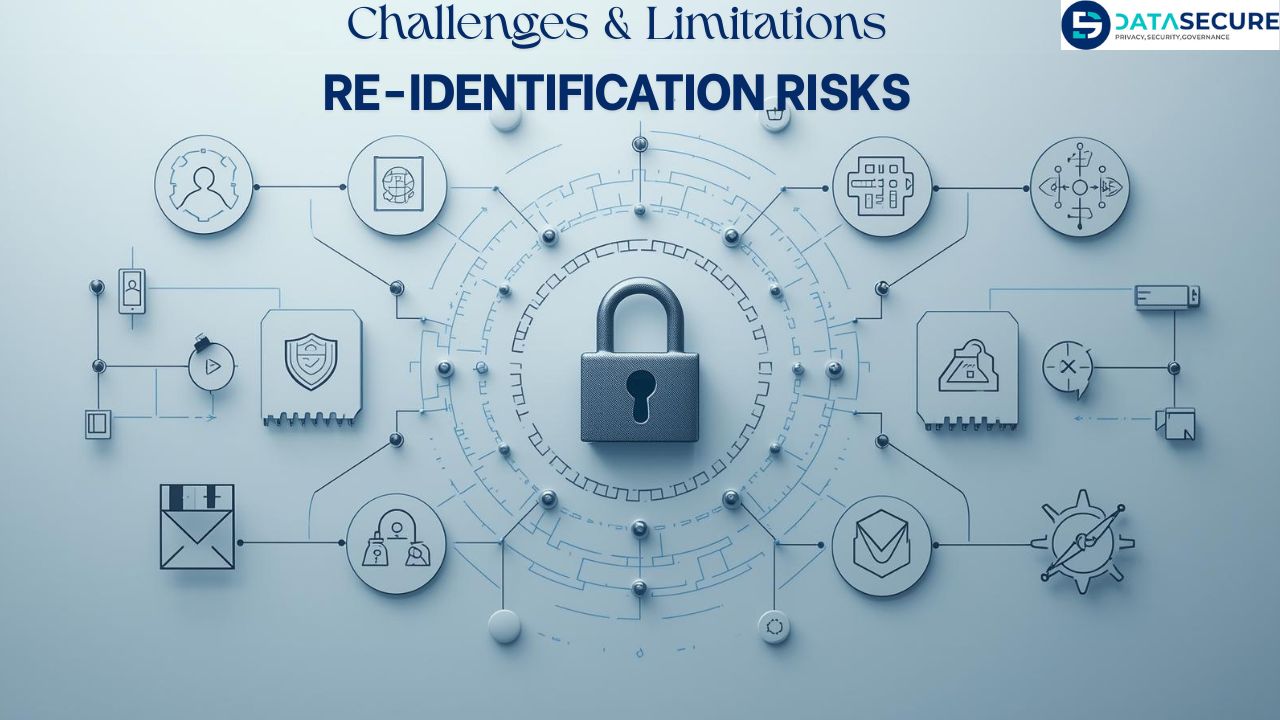
While anonymization techniques are essential, none are impervious to re-identification, which exploits weaknesses such as:
Data Linkability and Auxiliary Information
Anonymized datasets often retain quasi-identifiers attributes which, when combined with external data sometimes facilitate re-identification. The interconnected and open data environment exponentially increases this vulnerability. Even minor overlaps in datasets provide powerful clues for linking records back to individuals.
Evolving Techniques of Attackers
Machine learning and sophisticated statistical inference techniques can exploit subtle correlations and multidimensional data structures that remain even after anonymization. Computational advances now enable attackers to analyse exceptionally large datasets at high speed, weakening anonymity measures that were once considered sufficient. Additionally, adversaries increasingly use ensemble models and linkage attacks that combine multiple external datasets to infer hidden attributes with high accuracy. As publicly accessible data sources continue to expand, attackers gain more auxiliary information that further amplifies re-identification risks. Continuous improvements in computing power and AI-driven analytics ensure that anonymization methods must evolve rapidly to remain effective.
Utility versus Privacy Trade-off
Increasing anonymization strength typically involves generalization or noise addition, which reduces the precision of data and its analytical value. Finding the optimal balance where data is sufficiently protected but remains useful and meaningful is an ongoing dilemma faced by data custodians utility trade-offs.
Regulatory Ambiguity
Different countries and laws use different standards to decide whether data is truly anonymized. Under the GDPR, data must be anonymized so strongly that no person can be identified by any method that is reasonably likely to be used. The EDPB also warns that anonymization must remain effective even as technology improves. In the U.S., the HIPAA Privacy Rule allows anonymization through either the Safe Harbor method or Expert Determination, which are generally more flexible. Because of these differences, data that is anonymized for HIPAA may still not meet GDPR requirements. This inconsistency makes global data sharing difficult and increases compliance costs. Companies handling international data often need separate processes for each legal regime. Regulators may also interpret anonymization differently depending on the situation. As laws and expectations change, organisations must update their controls regularly. Overall, the lack of global alignment makes anonymization a complex challenge.
Resprentative Case Studies of Re-Identification
In the healthcare domain, research has shown that so-called anonymised electronic health records can be re-identified by matching them with external datasets such as voter registration or demographic data. For example, an analysis highlighted that even after removing direct identifiers, the attacker’s background knowledge and uniqueness of combinations of quasi-identifiers heavily influenced re-identification risk. This example underscores the urgency of comprehensive risk assessments that account for real-world data availability and attacker modelling.
Large-scale population datasets are likewise vulnerable: one study on country-scale anonymised data concluded that the risk of re-identification remains high even as dataset size grows, because unique combinations of seemingly innocuous attributes often persist. Thus, dataset size alone does not guarantee anonymity when quasi-identifiers are retained for utility.
Regarding anonymisation vendors and emerging techniques, commercial solutions often combine traditional anonymisation with synthetic data generation and newer methods such as avatarisation (re-positioning data points in high-dimensional space). While these layered approaches offer versatility and integration benefits, vulnerabilities still arise especially when ongoing risk evaluation is absent. Organizations must critically assess the privacy guarantees of these tools and not rely on vendor claims alone.
Practical Guidance for Enhancing Privacy Protection

Systematic Risk Assessment
Organizations must thoroughly evaluate re-identification risks before data release. This includes attacker modelling, sensitivity analysis, and adversarial testing with publicly available datasets. Applying structured methodologies and tools to measure re-identification probability is essential to decision-making.
Employing Layered Anonymization
Combining multiple anonymization methods (e.g., generalization alongside differential privacy) tailored to specific data types and contexts yields stronger guarantees. Innovations in adaptive anonymization algorithms that respond to new threat developments are promising paths forward.
Minimizing Data Exposure and Enforcing Access Control
Releasing only the minimum necessary data helps reduce the risk of re-identification. Limiting access to anonymized datasets through strict permissions further lowers exposure. Ethical data governance also requires being transparent with individuals about how their data is used. Strong consent practices ensure data sharing aligns with user expectations. Regular audits help check whether anonymization methods are still effective. Continuous monitoring allows organisations to respond quickly to new risks. Together, these measures create a safer and more controlled data-sharing environment.
Aligning with Legal and Ethical Frameworks
Compliance with laws such as the GDPR and HIPAA requires a clear understanding of how each regulation defines and evaluates anonymization. Organisations must ensure that their technical methods match these legal expectations and remain effective against evolving risks. Incorporating official regulatory guidance into system design helps avoid gaps that could lead to non-compliance. Maintaining proper documentation, including risk assessments and process records, is essential to demonstrate accountability. Ethical alignment also requires respecting individual rights, ensuring fairness, and preventing any harmful misuse of anonymized data.
Conclusion
Data anonymization remains essential for privacy preservation in an era of expanding data use and sharing. However, the fragility of anonymized data in the face of evolving re-identification tactics demands continuous, proactive management. Achieving an effective balance between privacy and utility necessitates rigorous risk assessments, multi-layered anonymization strategies, and stringent regulatory adherence. As the data landscape grows more complex, stakeholders must innovate and collaborate to secure privacy without compromising the transformative potential of data.
We at Data Secure (Data Privacy Automation Solution) DATA SECURE - Data Privacy Automation Solution can help you to understand EU GDPR and its ramificationsand design a solution to meet compliance and the regulatoryframework of EU GDPR and avoid potentially costly fines.
We can design and implement RoPA, DPIA and PIA assessments for meeting compliance and mitigating risks as per the requirement of legal and regulatory frameworks on privacy regulations across the globe especially conforming to GDPR, UK DPA 2018, CCPA, India Digital Personal Data Protection Act 2023. For more details, kindly visit DPO India – Your outsourced DPO Partner in 2025 (dpo-india.com).
For any demo/presentation of solutions on Data Privacy and Privacy Management as per EU GDPR, CCPA, CPRA or India DPDP Act 2023 and Secure Email transmission, kindly write to us at info@datasecure.ind.in or dpo@dpo-india.com.
For downloading the various Global Privacy Laws kindly visit the Resources page of DPO India - Your Outsourced DPO Partner in 2025
We serve as a comprehensive resource on the Digital Personal Data Protection Act, 2023 (Digital Personal Data Protection Act 2023 & Draft DPDP Rules 2025), India's landmark legislation on digital personal data protection. It provides access to the full text of the Act, the Draft DPDP Rules 2025, and detailed breakdowns of each chapter, covering topics such as data fiduciary obligations, rights of data principals, and the establishment of the Data Protection Board of India. For more details, kindly visit DPDP Act 2023 – Digital Personal Data Protection Act 2023 & Draft DPDP Rules 2025
We provide in-depth solutions and content on AI Risk Assessment and compliance, privacy regulations, and emerging industry trends. Our goal is to establish a credible platform that keeps businesses and professionals informed while also paving the way for future services in AI and privacy assessments. To Know More, Kindly Visit – AI Nexus Your Trusted Partner in AI Risk Assessment and Privacy Compliance|AI-Nexus